USArray

|
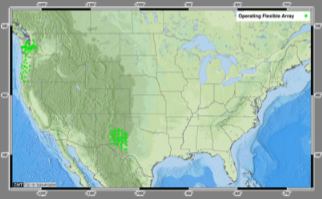
The Flexible Array is a pool of portable seismic instruments supported by the Array Operations Facility at the PASSCAL Instrument Center. The instruments are available for PI-driven research projects associated with the goals of Earthscope. The pool consists of broadband (325), short-period (100), accelerometer (20), and controlled source (1700) stations. |
 Flexible Array Page |
|
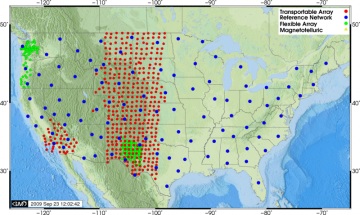
The Transportable Array is a telemetered network of 400 broadband stations. The array is being deployed in a uniform, rolling grid with 70 km spacing. Each station has a residency time of two years, after which the station is moved to the eastern edge of the array. |
 Transportable Array Page |
|
USArray, which is part of the EarthScope experiment, is a 15-year program to place a dense network of permanent and temporary seismographs across the continental United States. The seismographs record the energy released by earth movements, from the rumbling of cars on the highway to the seismic waves released by the hundreds of earthquakes that occur around the world every day. By analyzing the records of earthquakes obtained from this dense grid of seismometers, scientists can learn about Earth structure and dynamics and the physical processes controlling earthquakes and volcanoes. |
|